Handling Plateaus
Plateaus are the most common reason coaches change plans too early or too late. The instinct is to do something the moment progress stalls, but reacting to noise is as harmful as ignoring a genuine stall. This page covers how to tell the difference, what to check before making changes, and how to talk to clients about it.
Real plateau vs. normal fluctuation
A plateau is not one flat week. It is not two flat weeks. Weight, measurements, and strength all fluctuate naturally due to water retention, sleep quality, menstrual cycles, sodium intake, and stress.
A genuine plateau requires at least 3 consecutive weeks of stagnation in the context of good adherence. If the client hasn't been following the plan, what you're seeing isn't a plateau — it's an adherence gap.
Use the trend sparklines in the check-in review to see the last 12 data points at a glance.
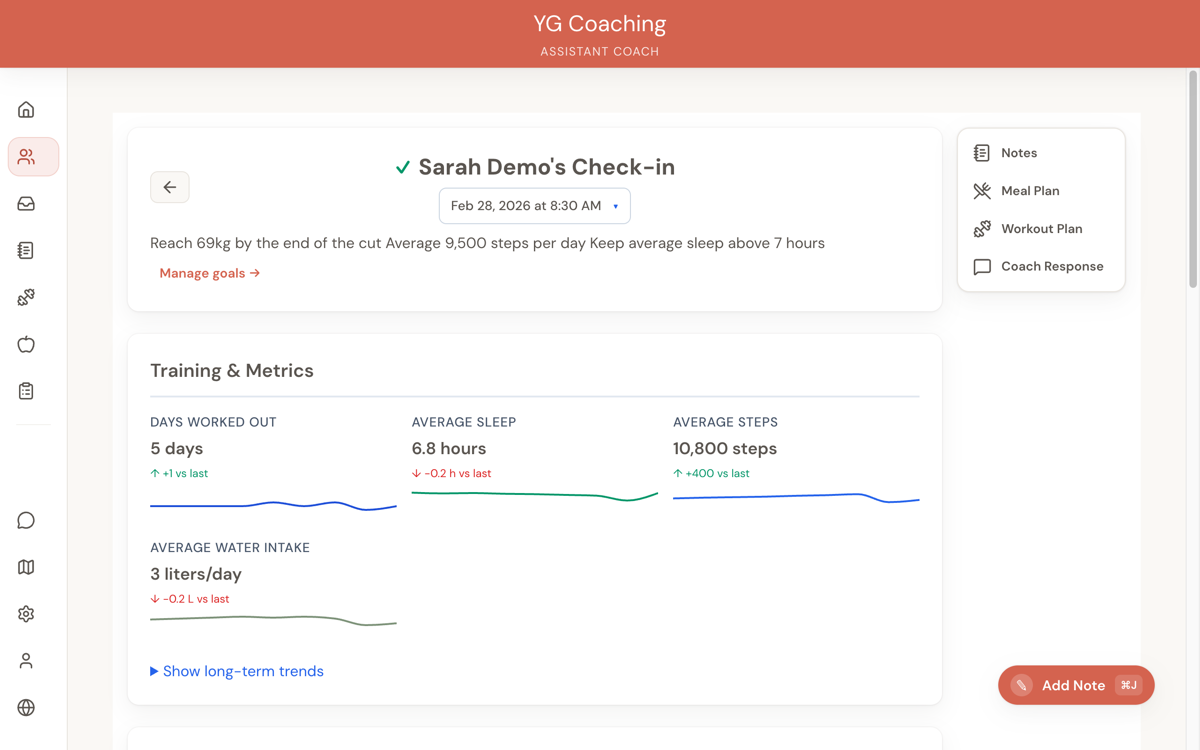 A flat line across 3+ check-ins is a plateau. A zigzag that averages out to no change over 2 weeks is noise.
For the fuller picture, run Trend Analysis on the client's dashboard. It pulls together check-ins, goals, and notes across your chosen time window and highlights what's actually stalling vs. what's still moving.
The diagnostic checklist
Before you change anything, work through these in order. Most "plateaus" resolve at one of the first three checkpoints.
1. Adherence
Is the client actually following the plan? Read their subjective check-in responses, not just the numbers. A client who reports "pretty good" adherence might mean 4 out of 7 days on plan. If adherence is below 80%, the plan is probably fine — the execution is the issue.
2. Sleep and stress
Poor sleep and elevated stress cause cortisol-driven water retention that masks real progress. A client losing fat but retaining water looks identical to a client not losing fat. Ask about sleep quality (not just hours), work stress, and life events.
3. Measurements and photos
Weight is one signal. Check waist and hip measurements. Compare progress photos from 3-4 weeks ago to now. If the waist is still trending down or photos show visible change, the client is making progress that the scale isn't capturing. This is recomposition, not a plateau.
4. Training performance
Are lifts still progressing? Is the client completing more reps or handling more volume? Improved training performance alongside flat weight often means muscle gain is offsetting fat loss — a good outcome that looks like a stall if you only watch the scale.
5. Timeline context
Where is the client in their programme? Someone 3 weeks into a cut should not be stalling. Someone 12 weeks in with 8kg already lost might be hitting a metabolic adaptation that's expected and normal.
Weight plateau with good adherence
You've confirmed: adherence is solid, sleep is decent, stress is manageable, and weight plus measurements have genuinely flatlined for 3+ weeks. Now you decide.
Adjust calories or increase activity?
This is the central question. The answer depends on where the client already is.
Increase activity first when:
- The client's step count or daily activity is low (under 7,000 steps)
- Calories are already moderate or low for their body size
- The client has room to move more without it feeling like a chore
Reduce calories when:
- Activity is already high and adding more would affect recovery
- The client prefers eating less to moving more (some do)
- The deficit has closed due to metabolic adaptation after extended dieting
How much to adjust:
- Activity: add 1,500-2,000 daily steps, or one extra 15-20 minute walk
- Calories: reduce by 150-250kcal, typically from carbs or fats, not protein
Duplicate the current meal plan, make the adjustment, and activate the new version. This preserves the client's history with the previous plan.
Example note: Weight flat at 82kg for 3 weeks. Adherence good (6/7 days on plan per client report). Sleep 7hrs avg. Measurements flat. Steps averaging 5,200/day — increasing step target to 7,000 before touching calories. Reassessing in 2 weeks.
Strength plateau
Strength stalls have different causes and different solutions than weight stalls.
Deload
If the client has been training hard for 5-6+ weeks without a reduction in volume or intensity, accumulated fatigue is the most likely cause. Programme a deload week — same exercises, same frequency, but reduce volume by 40-50% and intensity by 10-15%. Most clients come back stronger after a deload.
See Periodization & Progression for how to set up deload phases in the workout plan.
Exercise rotation
If specific lifts have stalled while others progress, the movement pattern may need a new stimulus. Swap the stalled exercise for a variation that trains the same muscle group. Flat bench stalling? Try incline for 4-6 weeks, then return to flat. This is often enough to break through.
Use Exercise Substitutions to find appropriate alternatives.
Programming change
If the client has been on the same rep scheme for 8+ weeks, progress may have stalled because the stimulus is no longer novel. Move from a hypertrophy block (8-12 reps) to a strength block (4-6 reps), or vice versa. Changing the rep range with the same exercises can restart progress without overhauling the programme.
Example note: Bench press stuck at 80kg x 5 for 4 weeks. Other lifts progressing. Swapping flat bench for incline DB press for the next 6-week block. Will return to flat bench after and reassess. If stall persists across movements, will programme a full deload.
The client conversation
How you talk about a plateau matters as much as what you do about it. A client who hears "you've plateaued" feels like they're failing. A client who hears "your body has adapted, and that tells us it's time to adjust" feels coached.
What to say
- Normalise it. "Plateaus are a normal part of the process. They happen to every single client, and they tell us useful information."
- Explain the data. "Your weight has been stable for 3 weeks, but your waist is still going down, which suggests you're gaining muscle while losing fat."
- State the plan. "Here's what we're going to do and why. We'll check back in 2 weeks to see if it's working."
- Set a timeline. "Give this adjustment 2-3 weeks before we assess. If we see movement, great. If not, I have a next step ready."
What not to say
- Don't blame the client unless adherence is genuinely the issue — and even then, frame it as problem-solving, not criticism.
- Don't promise the plateau will break by a specific date. You don't know that.
- Don't make multiple changes at once. If you cut calories and change the workout plan simultaneously, you won't know which one worked.
When to hold steady vs. when to change
This is the hardest judgment call in coaching. Here's a simple framework:
Hold steady when:
- It's been less than 3 weeks
- Adherence is inconsistent (fix that first)
- Other metrics are still moving in the right direction (measurements, photos, strength)
- Sleep or stress has been unusually poor (wait for it to normalise)
- The client is early in their programme and the initial rate of change was unsustainably fast
Make a change when:
- 3+ weeks of stagnation across multiple metrics
- Adherence is verified and solid
- Recovery factors (sleep, stress) are stable
- The current approach has had a fair trial period
- You've already held steady once and the stall continued
Example note: Held steady through weeks 8-10 after weight stalled at 74kg. Adherence strong, sleep fine, but photos showed continued visual improvement — suspected recomposition. Week 11: measurements also flat. Now adjusting: adding 2,000 steps/day target. Will reassess at week 13.
Using Trend Analysis to build the case
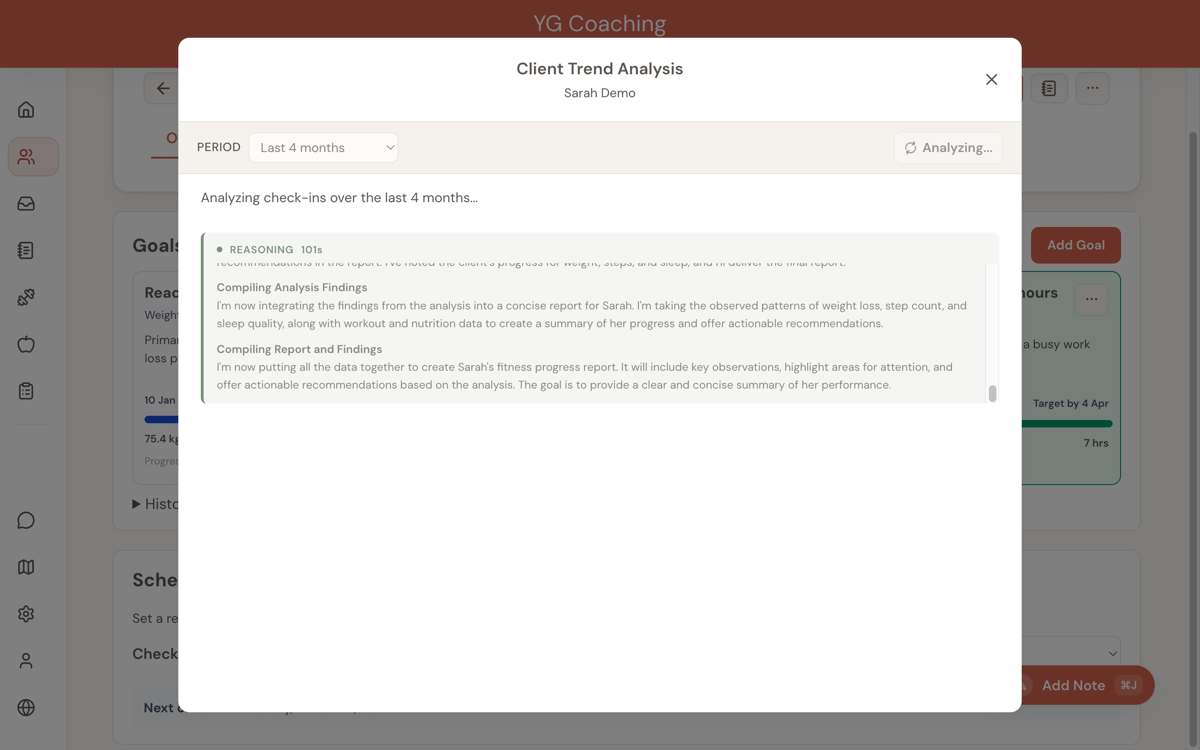
When you're deciding whether a plateau is real, Trend Analysis is your strongest tool. Run it with a 2-3 month window so you see the full trajectory, not just the recent flat period.
The analysis will highlight:
- Whether the stall is isolated to weight or shows up across measurements too
- How adherence has tracked over the same period
- What your notes say about recent changes (so you don't repeat an adjustment that already failed)
- Whether recovery metrics (sleep, steps, subjective energy) have deteriorated alongside the stall
Use this narrative to ground your decision. If you decide to adjust, reference the trend analysis in your note so future-you knows what data you were looking at when you made the call.
If you decide to hold steady, the trend analysis also documents why. Three months from now, when you're reviewing this client's history, you want to see a note that says "held steady because measurements were still improving" — not a gap where no decision was recorded.
Example note: Ran trend analysis (8 weeks). Weight flat since week 5, but waist down 1.5cm and training loads up 8% over same period. Holding plan steady. Client informed — recomposition likely. Will reassess weight + measurements together in 2 weeks.
Related guides:
- When to Change a Client's Plan -- the signals that tell you to adjust plans and when to hold steady
- Writing Great Check-in Responses -- what to write and how to frame good and bad weeks
- Reading Progress Photos -- what to look for in photos and how to communicate visual changes
- Periodization & Progression -- deloads, mesocycles, and progressive overload
- Phases & Variations -- cut/bulk transitions, refeed days, and nutrition adjustments