Setting Client Goals
Goals are the backbone of accountability in coaching. A well-chosen goal gives your client something concrete to work toward, gives you a clear signal of whether your programming is working, and makes check-in conversations more focused. A poorly chosen goal does the opposite — it creates pressure without direction, or tracks something that doesn't actually matter.
This page covers goal strategy: how many, what kind, what timeline, and when to change course. For the mechanics of creating and managing goals in the app, see Tracking Goals.
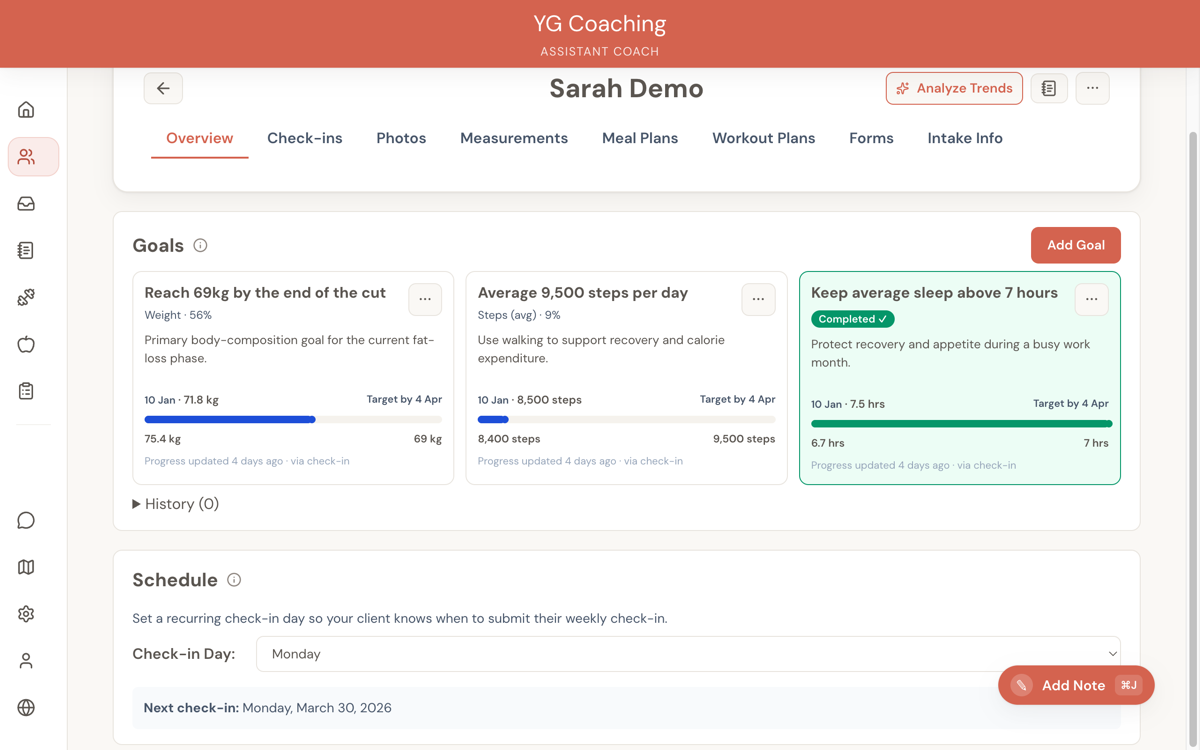
How many goals at once
Most clients should have two to three active goals at a time. One is too few — it puts all the emotional weight on a single number. More than three creates noise and dilutes focus.
The guideline:
| Client type | Active goals | Why |
|---|---|---|
| New client (first 4 weeks) | 1-2 | Keep it simple while habits are forming |
| Established client | 2-3 | One primary outcome, one or two process goals |
| Advanced / competition prep | 3-4 | More variables to track, higher compliance capacity |
A common pattern is one outcome goal (the result they care about) paired with one or two process goals (the behaviours that drive the result). More on this below.
If a client has five or six things they want to achieve, that's a prioritisation conversation, not a goal-setting one. Help them pick the two that matter most right now. The others go on a "future goals" list in their notes.
Outcome goals vs. process goals
This distinction matters more than most coaches think.
Outcome goals measure a result: lose 5 kg, add 20 kg to their squat, reach 15% body fat. The client can't directly control the outcome on any given day — it's the cumulative result of behaviour over time.
Process goals measure a behaviour: hit 10,000 steps daily, train four days per week, sleep seven or more hours per night. The client has direct control over these every single day.
Why you need both:
Outcome goals give direction — the client knows where they're heading. But outcome goals alone are dangerous because progress isn't linear. A client whose only goal is "lose 8 kg" will have weeks where the scale doesn't move despite doing everything right. Without a process goal to point to, those weeks feel like failure.
Process goals give daily wins. When the scale stalls, you can say: "You hit your step target every day this week and trained four times. The process is working — the outcome will follow." That's not hand-waving. It's accurate coaching.
Setting them up in the app:
Create outcome goals using metric types like Weight, Body fat percentage, or Exercise weight with a clear start and target value. Create process goals using Average steps, Average sleep, or Days worked out — these auto-track from check-in data, so the client sees progress without manual updates.
For goals that don't fit a built-in metric, use Free text (for qualitative targets like "complete a pull-up") or Custom with whatever unit makes sense.
Realistic timelines
Too aggressive and the client feels like a failure by week four. Too conservative and there's no urgency. These rates are general guidelines for natural clients with reasonable compliance:
Weight loss:
| Client profile | Sustainable rate | Notes |
|---|---|---|
| Significantly overweight (25+ kg to lose) | 0.5-1.0 kg/week | Higher initial rates from water loss are normal |
| Moderately overweight (10-25 kg to lose) | 0.5-0.75 kg/week | Steady deficit, minimal muscle loss |
| Leaning out (under 10 kg to lose) | 0.25-0.5 kg/week | Slower is better to preserve muscle |
| Already lean, cutting further | 0.2-0.3 kg/week | Aggressive deficits backfire here |
Muscle gain:
| Client profile | Sustainable rate | Notes |
|---|---|---|
| True beginner (first year) | 0.5-1.0 kg/month | Newbie gains are real |
| Intermediate (1-3 years) | 0.25-0.5 kg/month | Progress slows significantly |
| Advanced (3+ years) | 0.1-0.25 kg/month | Very slow; set longer goal windows |
Strength (main lifts):
| Client profile | Expected progress | Notes |
|---|---|---|
| Beginner | 2-5 kg/week on compounds | Linear progression works here |
| Intermediate | 2-5 kg/month | Periodisation becomes important |
| Advanced | Small PRs over months | Use exercise reps/weight goals with long timelines |
Calculating goal duration
Work backward from the target. If a client weighs 90 kg and wants to reach 80 kg at 0.5 kg/week, that's roughly 20 weeks. Set the duration to 22-24 weeks to buffer for holidays, illness, and slow weeks. The Duration (weeks) field calculates the end date automatically. Round up, not down — beating a goal early is motivating.
Goals for different client types
Weight loss — Use a Weight metric goal as the primary outcome. Pair it with a step count or training frequency process goal. Avoid body fat percentage as a primary goal for early-stage clients — measurement error is too high week to week. For large total losses, set the goal in phases (e.g., "first 10 kg" rather than all 30 at once). Completing intermediate goals builds momentum.
Muscle gain — Use Weight (gaining) or Exercise weight as the outcome goal. Scale weight alone is a blunt instrument during a gain phase — pair it with a strength goal for a clearer signal. Process goals can track training frequency or protein-related habits via free text or custom metrics.
Beginners — Lean heavily toward process goals. A beginner who trains three times per week and hits their step target is succeeding, regardless of the scale. Keep outcome goals conservative — it's better to set a target they'll beat than one that requires perfect adherence from day one.
Advanced clients — Longer timelines are essential. An advanced lifter adding 5 kg to their deadlift may need a 12-week goal. Use Exercise weight and Exercise reps metrics for lift-specific tracking. Process goals shift from basic consistency (they already have that) to sleep quality, training volume, and recovery habits.
When to adjust vs. push through
Adjust the goal when:
- The required rate of progress is no longer healthy or sustainable
- External circumstances have genuinely changed (injury, major life event, schedule change)
- The client's priorities have shifted and the goal is no longer relevant
- You're past halfway with less than a quarter of the progress, and the cause is structural
Push through when:
- The client is having a bad week or two — normal variance, not a trend
- Compliance is the issue, not the plan — adjusting the goal rewards poor adherence
- The client is frustrated but the data shows steady progress
- You're in the early weeks and the routine hasn't settled yet
The key question: "Has something changed about the situation, or about the client's feelings?" Situations warrant adjustment. Feelings warrant coaching.
When you do adjust, use the Edit function on the goal to update the target or end date. Don't abandon and recreate — you lose the progress history.
Using progress notes for accountability
Progress notes on goals create a written record of what happened, why decisions were made, and what the client committed to. They're visible to both you and the client, which makes them a powerful accountability tool.
Good uses for progress notes:
- Milestones: "Hit 80 kg today — halfway to target. Rate of loss consistent at 0.4 kg/week."
- Coaching decisions: "Extended goal by 4 weeks. Holiday travel cost 3 weeks of progress. New target date is realistic."
- Client commitments: "Agreed to prioritise sleep this month — targeting 7+ hours as the lever for the last 3 kg."
- Pattern changes: "Step count dropped from 10k to 6k over three weeks. New job has longer commute. Adjusted target to 8k."
When you review a client before writing their next plan, these notes give you context that raw numbers can't.
The psychology of goal completion
Celebrating wins
When a client completes a goal, mark it as Completed and write an achievement note. A good achievement note acknowledges the specific result ("You went from 92 kg to 80 kg in 22 weeks"), names the behaviour that drove it ("Your consistency with check-ins and training made this happen"), and connects it to what's next ("This sets us up well for the maintenance phase").
Completed goals live in the client's historical section permanently. Months from now, when they're grinding through a hard phase, you can point back to what they've already accomplished.
Reframing abandoned goals
Abandoning a goal isn't failure — but it feels like it to most clients. When the app asks for a reason, frame it as a strategic decision: "Replaced by a more relevant goal", "Timeline was unrealistic for current circumstances", or "Shifting focus to a more pressing need."
Avoid language that frames the abandonment as giving up. Acknowledge the pivot in your check-in response: "We're retiring the body fat goal and replacing it with a strength-focused target. The training data shows that's where the opportunity is right now."
Then immediately create the replacement goal. An abandoned goal without a successor leaves a void. A replaced goal is a course correction.
Related guides:
- Onboarding a New Client -- setting initial goals as part of the onboarding workflow
- Handling Plateaus -- when goal progress stalls and what to do about it
- Tracking Goals -- feature reference for creating and managing goals in the app