Your Weekly Workflow
Coaching one client is straightforward. Coaching ten or twenty means you need a system. This page covers how to structure your week so nothing falls through the cracks and your clients get consistent, timely attention.
The exact schedule depends on your business, but the pattern is the same: daily triage, batch reviews, weekly planning, and periodic deep dives.
Morning routine: triage your to-dos
Start every working day on the Home page.
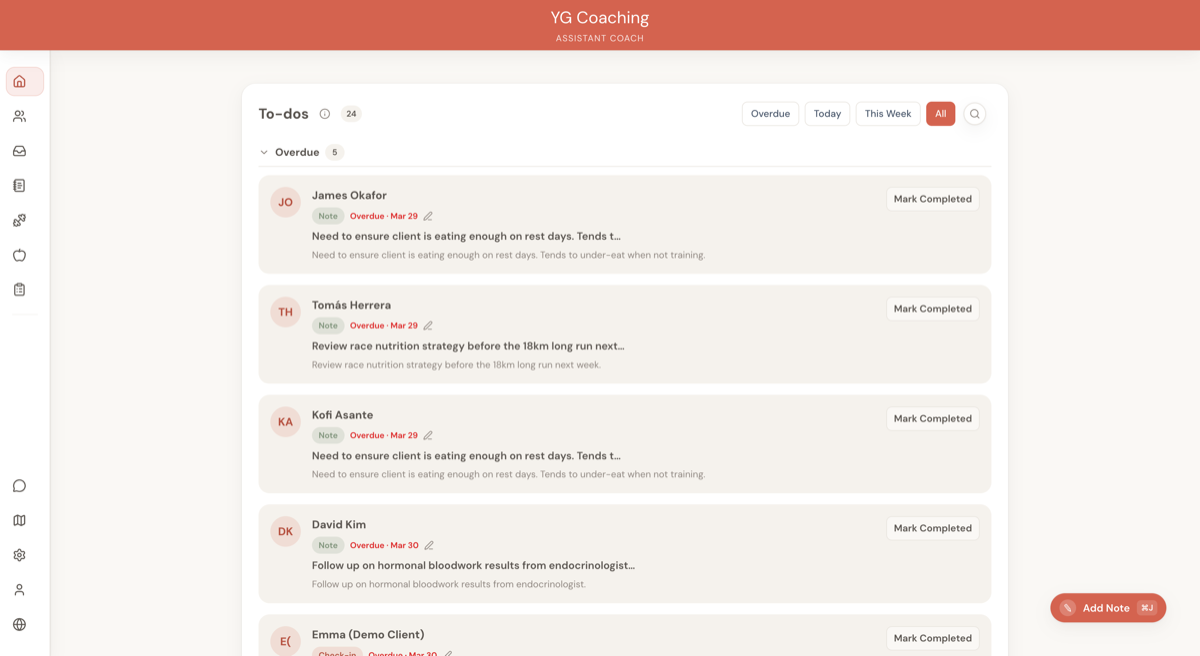 Your to-do list shows everything that needs your attention, ordered by urgency:
- Pending check-ins -- clients who have submitted and are waiting for your review
- Intake forms to process -- new clients who need onboarding
- Plans due -- meal plans or workout plans that are expiring soon
Scan the list and sort it in your head by priority:
- Intake forms first. New clients are most engaged in their first few days. A fast turnaround on their intake sets the tone for the whole coaching relationship. If someone submitted an intake form, process it before anything else.
- Overdue check-ins next. Any check-in that's been sitting for more than 24 hours should jump the queue. Clients notice when responses are slow, and it signals that you're not paying attention.
- Today's check-ins. Work through these in your batch review session (see below).
- Plan reviews. These aren't urgent minute-to-minute, but they shouldn't sit for more than a day or two.
This triage takes 2-3 minutes. The point is to know what your day looks like before you start working through items.
Batch check-in reviews
Reviewing check-ins is the core of your weekly work. Most coaches find that batching reviews into focused sessions is significantly faster than handling them as they trickle in.
How to batch effectively
-
Set a block. Dedicate 1-2 focused sessions per week for check-in reviews. Many coaches do Monday and Thursday, or whatever aligns with when their clients submit. Block the time like any other appointment.
-
Work through the list. Open each pending check-in from your Home to-do list. For each one:
- Scan the metrics and delta badges -- what changed since last week?
- Check the trend sparklines -- is the trajectory heading the right direction?
- Read the subjective feedback -- how is the client actually feeling?
- Review progress photos if submitted -- use the comparison viewer
- Glance at the actions sidebar to check their active meal plan and workout plan
-
Make your decision before writing. For each check-in, decide: does this client need a plan change, a goal adjustment, or just encouragement? Having the answer clear in your head before you start writing makes the response faster and more focused.
-
Write the response or queue it. If the response is straightforward, write it immediately. If it needs more thought (a plan change, a difficult conversation), make a note and come back to it after you've finished the batch.
Responding immediately vs. queuing
Not every check-in needs the same depth of response. Here's a rough split:
Respond immediately when:
- Everything is on track and the client just needs acknowledgment and encouragement
- There's a clear, simple adjustment to make (e.g., "bump calories by 100")
- The client asked a specific question that has a quick answer
Queue for later when:
- You need to build or modify a meal plan or workout plan
- The client is going through something that needs a thoughtful, carefully worded response
- You're seeing a trend that requires running Trend Analysis before you commit to a change
- You want to review their notes history before responding
Queuing doesn't mean ignoring. If you won't respond today, consider sending a quick acknowledgment: "Got your check-in, I'll have a full response for you by tomorrow." Clients care more about knowing they've been heard than about getting an instant essay.
If you use AI draft assistance for responses, batching is even more efficient. Generate drafts for several clients in a row, then go back and edit each one. The editing pass is much faster than writing from scratch, and reviewing drafts back-to-back helps you maintain a consistent tone.
Weekly plan review
Once a week, step back from individual check-ins and ask: which clients need plan adjustments?
The review process
-
Scan your full client list. Look for clients who have been on the same plan for 4+ weeks without changes. Staleness is the enemy of progress.
-
Check the signals. For each client on your radar, look at:
- Weight trend -- Has it stalled for 2-3 weeks? Moving in the wrong direction?
- Training adherence -- Are they hitting their sessions? If not, the plan might be too demanding.
- Subjective feedback patterns -- Are they consistently reporting low energy, poor sleep, or high stress?
- Goal progress -- Are active goals on track for their target dates?
-
Decide: adjust or hold. Not every stall needs a change. Sometimes the right move is to hold steady and give the current plan more time. See When to Change a Client's Plan for the full decision framework.
-
Make the adjustment. If a plan change is needed, duplicate the current meal plan or workout plan, make your modifications, and activate the new version. Add a note explaining what you changed and why -- your future self will thank you.
Common weekly adjustments
- Calorie adjustments -- Small bumps up or down (100-200 kcal) based on weight trends
- Volume changes -- Adding or removing a set, swapping an exercise, adjusting training days
- Goal updates -- Extending a timeline, adjusting a target, or closing a completed goal
- Form tweaks -- Adding or removing a check-in question based on what data you're actually using
Trend analysis for periodic deep dives
Individual check-ins show you the week. Trend Analysis shows you the arc. Use it for periodic deep dives rather than every check-in.
When to run trend analysis
- Monthly reviews -- Run a 3-month analysis for every active client once a month. This catches slow drifts that are invisible week-to-week.
- Before a phase change -- Before switching a client from a cut to maintenance, or from a beginner to intermediate programme, run an analysis to confirm the timing is right.
- When something feels off -- If a client's check-ins seem fine individually but your coaching instinct says something is wrong, trend analysis often surfaces the pattern you can't quite put your finger on.
- After returning from a break -- If you or a client missed a couple of weeks, a trend analysis gets you back up to speed faster than reading through individual check-ins.
How to use the output
Open the client's dashboard and click Trend Analysis. Choose your time period (1-3 months for a focused snapshot, 6-12 months for the big picture) and click Analyze.
The analysis pulls together check-in metrics, goal progress, and your notes into a narrative. Look for:
- Adherence percentages -- Are they actually following the plan?
- Measurement correlations -- Weight stable but waist dropping? That's recomposition, not a stall.
- Mood and energy patterns -- Subtle declines that don't show up in any single check-in
- Goal trajectory -- Whether current progress rate will hit the target date
Don't treat the analysis as a verdict. It's a starting point for your own coaching judgment.
Daily, weekly, and monthly rhythm
Here's a practical breakdown of what to do at each cadence:
Daily (10-15 minutes)
- Triage the Home page to-do list
- Process any intake forms immediately
- Respond to any overdue check-ins
- Quick replies to straightforward check-ins if time allows
Weekly (1-2 focused sessions)
- Batch check-in reviews and responses
- Review which clients need plan adjustments
- Update or create meal plans and workout plans as needed
- Clear any remaining to-do items
Monthly (30-60 minutes)
- Run Trend Analysis for each active client (3-month window)
- Review goal progress across your roster -- are targets realistic?
- Audit your check-in form templates -- are you asking for data you actually use?
- Review your notes for each client -- anything you've been meaning to address?
The daily work keeps things moving. The weekly sessions are where the real coaching happens. The monthly reviews prevent slow problems from becoming big ones.
The monthly review is the most commonly skipped part of this workflow, and it's the part that separates good coaches from great ones. Block it on your calendar. Treat it like a client session -- it is one, for your business.
Related guides:
- Writing Great Check-in Responses -- how to write responses that drive client outcomes
- Managing Multiple Clients -- scaling your workflow to a full roster
- When to Change a Client's Plan -- the decision framework for plan adjustments
- Reviewing Check-ins -- feature reference for the check-in review interface