Writing Great Check-in Responses
Your check-in response is the main touchpoint between you and your client each week. It's where coaching actually happens. A good response makes the client feel seen, understood, and clear on what to do next. A generic one makes them wonder why they're paying for coaching.
This page covers the coaching skill of writing responses. For the editor itself, see Writing Responses.
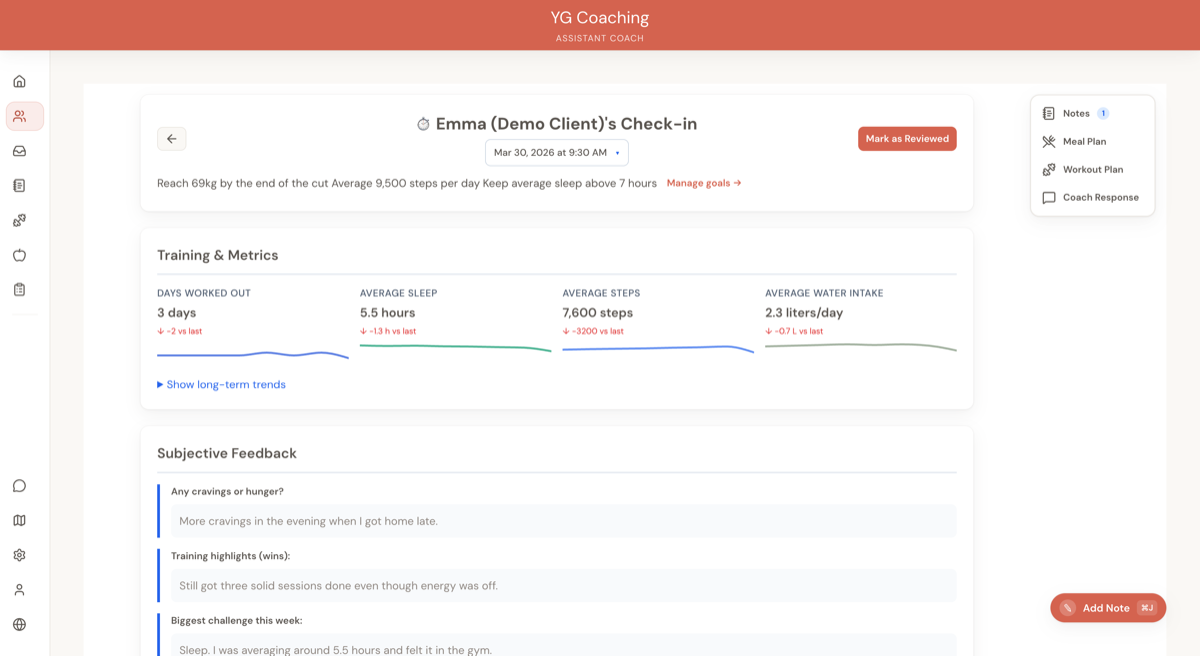
Anatomy of a good response
Every effective response hits four beats. You don't need a rigid template, but these elements should be present:
1. Acknowledge — Show you've actually read their check-in. Reference something specific: their weight, a struggle they mentioned, a training session they flagged. This proves you're paying attention, not copy-pasting.
2. Analyse — Interpret the data for them. Clients submit numbers; your job is to explain what those numbers mean. Is the trend moving in the right direction? Is a plateau expected? Is a weight spike just water retention?
3. Action — Give them something concrete to do or continue doing. This is the most important part. Every response should leave the client knowing exactly what to focus on next week.
4. Encouragement — End on a forward-looking note. Not empty cheerleading, but genuine reinforcement of what's working or confidence that the plan is right.
Here's what this looks like in practice:
Great week, Sarah. Weight is down 0.4kg which keeps you right on track with the 0.5kg/week target — slow and steady is exactly what we want here. Your training adherence was perfect at 4/4 sessions, and the fact that you're finding the leg days easier tells me your work capacity is improving.
For this week, keep everything the same. Macros are working, training is progressing, and there's no reason to change anything when the trend is this consistent. The one thing I'd like you to focus on is getting your step count closer to 8,000 on rest days — you've been averaging around 6,000 and that extra movement will help with recovery and keep your deficit where it needs to be.
Keep it up. You're 6 weeks in and the consistency is showing.
That's acknowledge (weight trend, training adherence), analyse (on track, work capacity improving), action (maintain plan, increase rest day steps), encouragement (consistency is paying off).
How to frame a good week
When a client has a strong week, your instinct might be to pile on the praise. Resist it. Over-praising makes your feedback feel less meaningful over time, and it sets up a contrast problem — if you celebrate every good week, what does a bad week feel like?
What works:
- Be specific about what was good. "Your adherence was 100% and your weight dropped 0.3kg" is better than "Amazing work this week!"
- Connect the result to their effort. "That weight drop is a direct result of you sticking to the plan even on the weekend" reinforces the behaviour you want repeated.
- Use it as evidence. "This is three weeks in a row of consistent progress — the plan is clearly working for you" builds their trust in the process.
What to avoid:
- Excessive exclamation marks and superlatives. "INCREDIBLE!! SO PROUD!!" sounds like social media, not professional coaching.
- Praising baseline expectations. Hitting macros and completing sessions is the standard. Save real praise for extra effort.
Solid week, Tom. Weight is holding steady at 88.2kg which is exactly what we want during this maintenance phase — no drift in either direction. You mentioned the workouts felt easier this week, which makes sense because we dropped the RPE on your compounds last phase. That's the adaptation kicking in.
This week I'm going to bump your squat and bench working weights up by 2.5kg each. Everything else stays the same. Let me know how the new weights feel in your next check-in.
Notice the tone: calm, professional, forward-looking. The client knows they did well without being showered in praise.
How to frame a bad week
Bad weeks are where coaching skill matters most. The client already knows it was a bad week — they filled out the check-in. They don't need you to tell them they messed up.
The principles:
- Don't lecture. They're adults. Saying "you need to be more consistent" adds nothing. They know.
- Normalise it. Everyone has off weeks. Acknowledging that this is normal reduces the shame spiral that leads to more bad weeks.
- Find the signal. A bad week usually has a reason. Dig into it. Was it a life event? A schedule disruption? A plan that's too aggressive?
- Give them a path forward. The worst thing you can do after a bad week is leave the client with no clear next step.
Tough week, and that's okay — it happens. Weight is up 1.2kg but looking at the context, you had a work dinner on Wednesday and a birthday on Saturday, so a lot of that is likely water and food volume rather than actual fat gain. I'd expect most of that to come off by next week if you get back to normal eating.
Here's what I want you to focus on: just hit your training sessions this week. Don't try to "make up" for last week by cutting calories lower or doing extra cardio. That always backfires. The plan is the plan — trust the weekly average and let one off week be one off week.
You've been consistent for 7 of the last 8 weeks. That's a great track record. One week doesn't undo that.
The response acknowledges the bad data without dramatising it, provides an explanation, gives a clear action (just follow the plan), and reframes by zooming out to their overall consistency.
Handling non-compliance
Non-compliance is different from a bad week. A bad week is "life got in the way." Non-compliance is "the client isn't following the plan" — missed sessions, consistently off macros, skipped check-ins.
You have two tools: practical adjustment and motivational reinforcement. The right choice depends on why.
When the plan is the problem
If a client is consistently failing to hit their targets, the plan might be unrealistic — training adherence stuck at 2/4 for weeks, macros consistently 300+ calories off, client feedback mentioning overwhelm or exhaustion.
In this case, adjust the plan downward. Compliance with an easier plan beats non-compliance with an optimal one.
I've noticed you've been hitting 2 out of 4 sessions for the last three weeks. That's not a motivation problem — that's a scheduling problem. Let's drop to 3 sessions per week and make those 3 sessions count. I'd rather you be consistent with 3 than stressed about missing the 4th. I've updated your workout plan to reflect this — take a look and let me know if the new schedule works better.
When motivation is the problem
If the plan is reasonable but the client has disengaged — adherence dropping gradually, short check-in responses, goals feeling distant — a plan change won't help. They need a conversation. Be direct but empathetic. Ask what's going on. Don't pretend everything is fine.
I want to check in on something bigger than this week's numbers. Your adherence has been dropping over the last month — from 4/4 sessions down to 2/4, and your macros have been more off than on. That's not like you, and it usually means something else is going on. Is the motivation dipping, or is there something outside of training that's making it harder to stay on track?
No judgement here — I'd rather know what's happening so we can adjust than have you quietly disengage. If the current goal isn't exciting you anymore, we can talk about changing direction. If life is just chaotic right now, we can simplify things until it settles.
When to use AI drafts vs. write from scratch
The AI draft feature generates a response based on the check-in data, your writing style, and client context. It's a time-saver, but it's not always the right tool.
Use AI drafts when:
- The check-in is straightforward — steady progress, no major issues
- You have many check-ins to review and need throughput without sacrificing quality
- You want a solid starting point to personalise with a few edits
Write from scratch when:
- Something sensitive came up — injury, personal issue, major setback
- The client needs a direct conversation about compliance or goals
- The tone needs to be very different from your usual style (e.g., a serious talk vs. your normally upbeat tone)
In practice, most coaches use AI drafts for 60-70% of responses with light editing, and write from scratch or heavily rewrite the other 30-40%.
How notes feed into AI drafts
The AI reads your notes from the last 30 days when generating a draft. This means your notes are a direct input into the quality of your AI responses.
Strategic note-writing for better drafts:
- Before generating a draft, add a note about what you want the response to address. "Next response should push back on the idea that cardio will fix the plateau — the issue is adherence, not energy expenditure."
- Notes linked to the current check-in are treated as must-address items. Use this when you want the draft to definitely cover something specific.
- General client notes from the last 30 days provide background context. The AI uses these to avoid contradicting your recent coaching decisions.
- The most useful notes cover: what's driving a trend, coaching direction for the next phase, the client's emotional state, and topics to address or avoid.
See Coaching Scenarios for more on using notes effectively.
Response length and tone
Clients don't read essays. The research on client engagement is consistent: shorter, actionable responses get better outcomes than long ones.
Length guidelines:
- 150-300 words for a standard weekly response
- Up to 500 words for significant discussions (plan change, plateau analysis, goal reset)
- Under 100 words only if deliberately brief ("Great week, no changes, keep going")
Tone:
- Write like you'd talk to a client in person. Professional but human.
- First person, direct address. "I'm going to increase your calories" not "Your calories will be increased."
- Avoid jargon unless the client uses it too. "We're going to eat a bit more" beats "We're implementing a reverse diet protocol."
- Match the client's energy. If they wrote two enthusiastic paragraphs, a three-line response feels dismissive.
Examples for common situations
Plateau (weight stalled, client is frustrated)
I know the scale not moving for two weeks is frustrating, but let's look at the bigger picture. Your waist measurement is down 1cm since last month, and comparing your photos from week 1 to now, there's a visible difference in your midsection. Body composition is changing — the scale just hasn't caught up yet.
I'm not going to change your macros right now. The data says the plan is working, and dropping calories at this point would just make you hungrier without speeding up the process. Let's give it one more week at current intake. If the scale still hasn't moved by next check-in and measurements are also flat, we'll make an adjustment.
Adherence drop (client hit 2/5 sessions, missed macros)
Looks like this week was rough — 2 out of 5 sessions and macros were off most days. It happens, and the important thing is you still checked in. One bad week in a streak of good ones doesn't change the trend.
This week, just focus on 3 sessions and hitting your protein target each day. Don't worry about the other macros being perfect. Sometimes simplifying for a week is what you need to get momentum back.
Big win (client hit a major milestone)
100kg bench press — that's a genuine milestone and you should be proud of it. When you started 8 months ago your working weight was 60kg, so this has been a long time coming.
Now that you've hit this target, let's talk about what's next. I've set your new bench goal to 110kg with a 12-week timeline. We'll run a short deload next week, then start the next strength block. Updated plan will be ready by Monday.
Injury report (client mentions new pain)
Thanks for flagging the shoulder pain — that's exactly what I need to know about. Sharp pain at the top of overhead press but fine during bench and lateral raises sounds positional, but I'm not a physio and I don't want to guess.
I've swapped overhead press for landmine press this week, which should be pain-free at that angle. If it persists or gets worse, I'd recommend seeing a physiotherapist. I'll check in on this again next week.
Related guides:
- Your Weekly Workflow -- structuring your coaching week
- Reading Progress Photos -- what to look for in client photos
- When to Change a Client's Plan -- signals for plan adjustments
- Writing Responses -- feature reference for the response editor
- Coaching Scenarios -- using notes for AI context