Reviewing Workout Logs
When a client completes a workout, it appears in the Logs sub-tab under the Workouts section on their dashboard. You can drill into each workout, see exactly what they did, and give feedback.
Finding workout logs
On a client's dashboard, go to the Workouts section. You'll see two sub-tabs:
- Plans — Your workout plan management (creating, editing, activating)
- Logs — Completed workout history with adherence stats
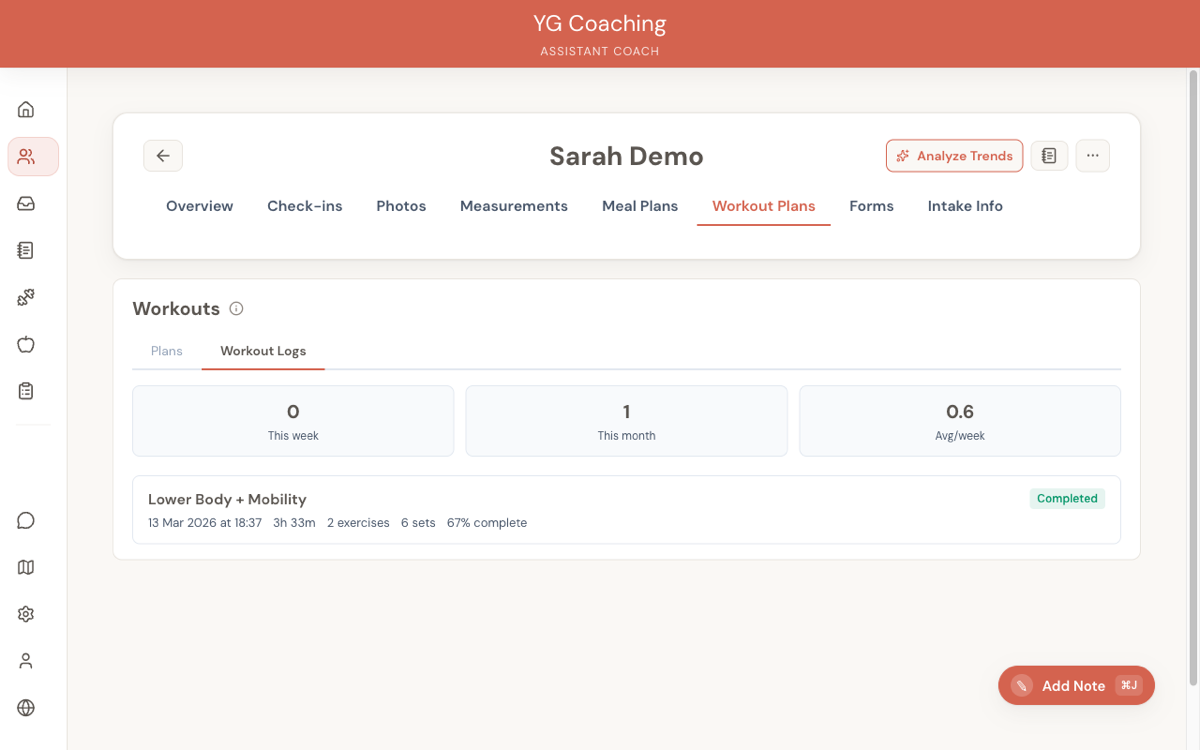
The Logs tab shows workouts in reverse chronological order (newest first).
Adherence stats
At the top of the Logs tab, summary stats give you a quick read on the client's consistency:
- Workouts this week
- Workouts this month
- Average sessions per week
Workout log cards
Each workout log card shows:
- Session name (e.g., "Upper Body Day 1")
- Date and duration
- Total volume
- Completion: exercises completed / total, sets completed / prescribed
- Status badge — Completed or Incomplete
Drill-down detail
Expand a workout card to see the full exercise-by-exercise, set-by-set breakdown:
- Exercise name with prescribed target (e.g., "4 × 10 @ 135 lb")
- Client note — If the client left exercise-specific context such as pain, substitutions, or effort notes, it appears above the set list for that exercise
- Each set: actual reps × weight, with delta indicators showing how the client compared to their prescription (e.g., "▼5lb", "▲2 reps")
- Skipped exercises — Clearly marked if the client didn't log any sets
- Added exercises — Exercises the client added mid-workout (not in the plan) show with an "Added by client" badge so you can see what extra work they chose to do
- Client workout note — If the client wrote whole-session context, like low energy, pain, equipment swaps, or why they changed the workout order
- PRs — Any personal records hit during the session
Giving feedback
Open any workout and scroll to Session feedback at the bottom. This is your note on the whole workout — training cues, encouragement, adjustments for next time. Type it, or tap 👍 or ❤️ for a quick reaction, then select Send feedback.
- Once sent, your feedback shows as a note with the time you sent it, the same way your other comments look
- Select Edit on the note to change it, or Remove to take it back (you'll be asked to confirm first)
- If you close the workout or move to another session with feedback typed but not sent, it's saved for you
- Feedback is visible to the client in their workout history
- The client's workout note appears near the top of the workout, and exercise-specific client notes stay visible above the matching set list, so you can read their context before writing feedback
This works similarly to check-in responses — a direct coaching touchpoint tied to a specific workout.
Commenting on a specific exercise
Sometimes your feedback is about one exercise, not the whole session — a reply to a note your client left, a word on the weight they chose, or a quick cue. Under each exercise in the workout you'll see Add a comment.
- Works on any exercise, whether or not your client filmed it — so a note like "the glute machine was taken, so I used the Smith machine" never goes unanswered.
- Add a short reply and, if it helps, up to four photos (for example a setup or form reference).
- Your client sees it as a Your coach note right under their own note for that exercise, and gets a notification that you commented.
- There's one comment per exercise, and it's yours to change — Edit to reword or add to it, Remove to take it down.
This is separate from the whole-workout feedback above, and from comments you pin to a moment in a workout video — each one shows up right next to what it's about, so your client always knows what you're responding to.
When your client replies
Your comment isn't a dead end. After you comment on an exercise, your client can add one short reply — a quick bit of context like "my knee felt off on set 3" or "dropped the weight because the rack was taken." It's capped at a single reply on purpose: it's there to give you the piece that makes your feedback land, not to open a back-and-forth chat.
When a client replies:
- Their reply shows up right under your comment when you open that workout, so the context sits next to what it's about.
- You get an in-app notification that opens the right workout and takes you to the reply. Once the reply is on screen, it is marked as read automatically.
- There is no email or push notification for this reply.
You don't have to reply back. Read it, let it inform your next comment or plan tweak, and move on.
Clients reply from the completed workout in their workout history. The quick Coach's last note reminder shown while they log a later workout is read-only, so any reply stays attached to the original session. Timestamped feedback on an exercise video is also read-only; the reply control applies to the exercise-level comment under the logged exercise.
Find a lift fast
You don't have to remember which session a lift was in. At the top of the Logs tab there's a search box — start typing an exercise name and you'll see the exercises this client has actually logged, most recent first, each with when they last did it.
Pick one and its full history and trends open straight away. It's the quickest way to answer a question like "how's their squat moving this month?" while you're reading a check-in or planning their next block — without scrolling back through past sessions to find one that has the lift.
Exercise trend graphs
From the Logs tab, you can view per-exercise performance trends to assess progression:
- Weight — Best weight per session over time
- Volume — Total volume (sets × reps × weight) per session
- Estimated 1RM — Using the Epley formula
These are the same graphs your client sees in their client app, giving you a shared reference point for coaching conversations.
Goal integration
When a client completes a workout, any goals linked to exercises in that session update automatically. For example, if a client has an "Increase bench press to 100 kg" goal and they hit 95 kg in today's session, the goal progress updates without anyone touching it.
You'll see the updated progress on the Goals tab — no need to manually cross-reference workout logs with goal targets.